People5 min read
Gertrude Colley Murphy
A Rebel at 129 Ferguson Road · Shared by Chris Moran
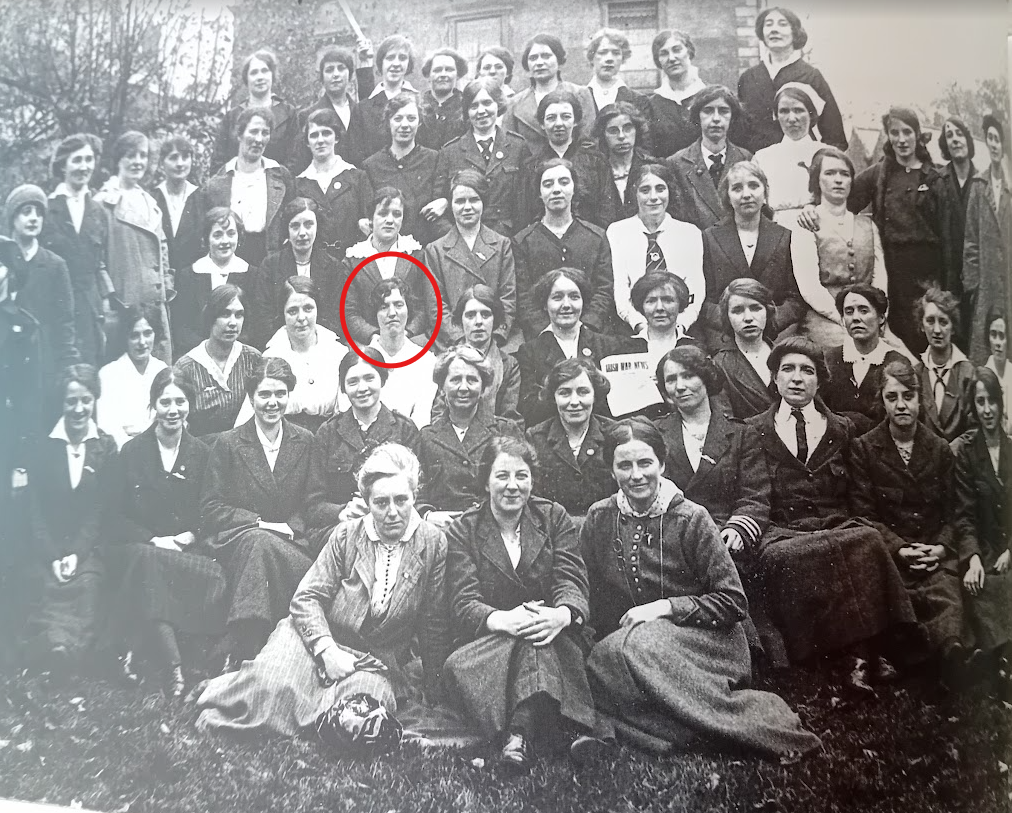
In 1929, 129 Ferguson Road was first leased to James SwaineOn Holy Thursday ahead of Easter Sunday 1916, Harry Colley returned home to 69 Clonliffe Road for supper with his Mam and sisters. His eldest sister Gertie asked, 'Did you hear anything?' Harry replied, 'It’s coming off on Sunday from what I could understand from Tom MacDonagh tonight.' 'I think so too' she said, 'from what I heard.' Like her younger sister, Gertie at 22 years of age, was a member of the Fairview Branch of Cumann na mBan.
Cumann na mBan provided support across all levels of need by the insurgents, from keeping the information channels open to moving guns around the outposts, their catering corps feeding the army. If their role is viewed as traditional by today's sensibilities, Cumann na mBan did not have a problem with this.
After early Mass on Easter Sunday Gertie and Harry were astounded to read Eoin McNeills countermanding orders in the Sunday independent. All was off, for the moment.
Around 2 o'clock on the afternoon of Easter Monday just as she returned from Mass, a mobilisation order came through for the widow Jane Colley's children. While her brother Harry was ordered to Father Matthew Park, Gertie was instructed to report to the G.P.O. Mother Colley took her son and daughter in her arms, kissed them and told them to go and do their duty for their country.
Gertie Colley was born in Dublin in 1893, one of eight siblings. Her family were originally shopkeepers in Rathfarnham.
En route to the GPO Gertie found the city in a state of confusion.
Arriving alongside the Irish Citizen Army, the members of Cumann na mBan commanded the kitchen on the top floor of the GPO and the makeshift hospital to the rear on the ground floor.
With the whole garrison in knowledgably in danger of death, the Chaplain to the Volunteers gave absolution to everyone in the GPO as they knelt and said an Act of Contrition before him.
Gertie recalled an impressive scene where 'men of all walks in life, unshaven, unwashed and all so serious turned to prayer, the 'girls with rosary beads hanging around their necks all of the time,' the rosary giving the rebels immediate access to a spiritual need at this time of peril and emotional stress. They prayed:
'O queen of paradise, mother and maiden,
mirror of graces, of angels and saints,
I place the custody of my soul in your hands. O Mary don't refuse me and I'll be safe'
By the second day Gertie had ''lost all idea of time.'' The women rested in two-hour shifts, on mattresses on the floor while Brian O'Higgins patrolled the corridor outside their room. They were rebels, but socially conservative and Catholic to the end.
On the Thursday, day four, Gertie volunteered to take food to ''the men along the Henry Street windows'' in another part of the GPO. Those men were directly under fire and unable to leave their posts.
''So we loaded our trays and made our way through holes which had been blown in the walls.' Offering tea and food under heavy fire, shielding herself against the door jambs to avoid the barrage of bullets she pushed through a room and 'saw a sight that made me feel sick…''
She saw a body with it's head completely blown, but she didn't stop. Later she realised that what she had seen was just a decapitated wax figure from the Dublin waxworks on Henry Street.
At 4.20pm on the Friday afternoon of Easter week a British field gun opened up on the GPO from the direction of North Earl Street. A column of smoke rose from the GPO. When the roof caught fire the Volunteers abandoned their efforts to stop the flames as the fire took hold, burning downwards, floor after floor. Ammunition and explosives were moved to the basements and the garrison was finally assembled together and ordered to prepare for evacuation. Men were seen carrying bread boards full of homemade bombs with damp sacks placed across them for fear they would light and explode. There was a grave danger that the ceiling would collapse.
Patrick Pearse called the women together to thank them and praise them for their work and instructed Gertie directly.
''Pearse addressed us and thanked and praised us for our help … Pearse handed me a large Red Cross flag, and then we received our orders. We were to proceed down Henry Street to Jervis Street hospital.''
Gertie Colley led the first group, carrying a flag with a Red Cross insignia up Henry Street.
''As the door of the GPO was about to be opened, Pearse called out: ‘Girl with the flag, march to the centre of the street’. It was only a matter of seconds before the others joined us, but my legs felt like jelly. We turned into Henry Street to be confronted with our first [British Army] barricade. I scrambled up and held the flag on the top while the others got through at the side.'
They were placed under a military escort and marched to the Broadstone Railway station at Great Western Street where they were given tea and biscuits and each interviewed about events in the GPO. Finally Gertie was given a signed pass allowing her to go home to Jane and Jenny.
Gertie went on to marry Jack Murphy and have eight children, living at 129 Ferguson Road from the 1930s until the 1970s. Throughout that time she struggled to get her 1916 military service recognised because she had been deemed to have left her post in the GPO, even though this was on the orders of Patrick Pearse. This also despite her subsequent involvement with anti-conscription in 1917 and being at the call to arms in Barry's Hotel as part of the Anti-Treaty forces following the Free State bombardment of the Four Courts in 1922. It took then sworn testimony and intervention of former IRA man and acting Officer Commanding, Frank Henderson to finally obtain approval for the pension award.