People3 min read
Roisin Dowd Murphy
Colourful, idiosyncratic & painterly · Shared by Réiltín Murphy
The artist Róisín Dowd's parents fled the Belfast blitz in 1941 to settle in Dublin. Róisín met her husband, artist John Murphy, during their National College of Art days in Dublin. Together and separately, they travelled to Paris and Rome, doing what art students do – visiting galleries and studios, studying centuries of European painting, absorbing and responding to those influences (Botticelli for Róisín, Klimt for Johnny), finding their artistic voices and refining their own styles.
Returning home, they had to wait for several years to marry. Their daughter Réiltín suspects that Grandfather Dowd insisted on his future son-in-law having gainful employment and that may have been why he joined the Harry Clarke Studios in 1952 and began to seriously study the craft of glass painting. Harry Clarke died in 1931 but his studios carried on making stained glass until the 1970s. There was plenty of work for anyone in the ecclesiastical provisioning business as new churches were going up all over the country to serve the burgeoning, and pious, population.
Johnny Murphy had met the Harry Clarke Studios master craftsman John A (Dessie) Devitt and in 1955 they decided to strike out on their own taking two of their friends from the Harry Clarke Studios with them. Roisin, Johnny and Des, along with Paddy McLoughlin and Micky Watson, set about doing something entirely new and different in stained glass in Ireland, bringing with them their art training, their modern aesthetic sensibilities, and their deep knowledge of and commitment to their craft. Working from a mews in Monkstown and later a custom-built studio in Blackrock, they started to tender successfully for new commissions. This allowed Róisín and Johnny to develop their own unique approach to designing and painting stained glass.
By all accounts it was a charmed workplace, a happy environment where everyone worked hard but where laughter and The Chat abounded. Des in particular was gifted with the ability to recognise the absurd and could hardly leave the studio without coming back with an entertaining story.
The early 1960s brought a huge church building boom and the small Murphy-Devitt Studios was extremely busy making windows for Ireland and abroad.
The first Murphy-Devitt Studios window that we are aware of is in Wah, Pakistan and dates to 1955 - their final window is in St. Peter’s Cathedral, Belfast and dates to almost sixty years later.
It was a relationship that lasted almost fifty years, most notably in the form of Murphy/DevittStudios Limited from 1969-1990.
Shortly after the passing of Des Devitt, Johnny was quoted as saying “we only ever wanted to create the best work we possibly could and we were happy that we did”. By 2006 Des, Johnny and Róisín had all passed away but their legacy of literally hundreds, quite possibly thousands, of the most avant-garde, radical and truly beautiful stained glass windows live on in the churches, public buildings and homes of Ireland and beyond.
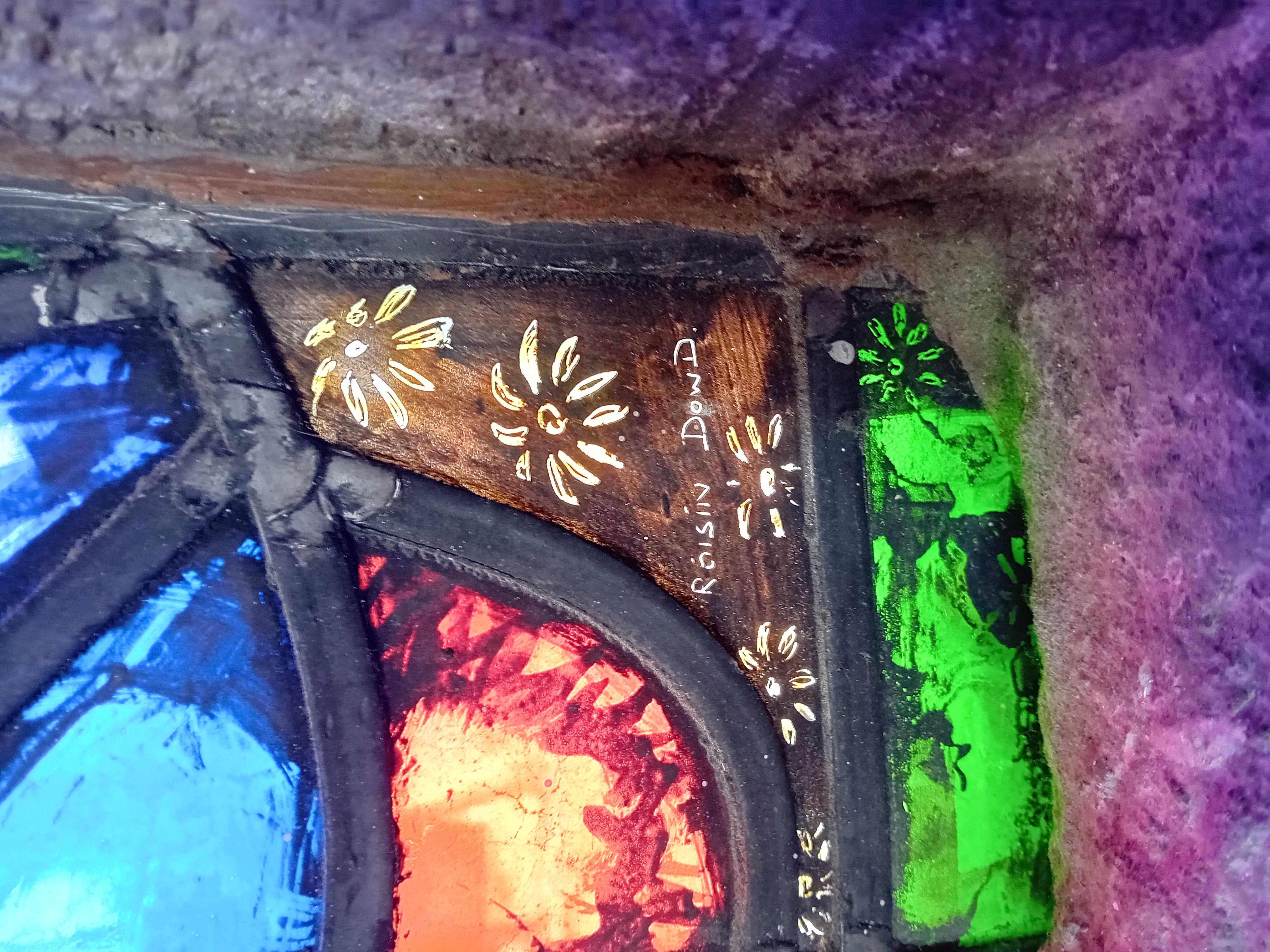
The distinction between a a Róisín Dowd Murphy window and a Johnny Murphy window is sometimes quite clear: Johnny’s style is more angular, with loose dark brushstrokes, strongly marked facial features, heads tilted at an angle, while Róisín’s figures are more curvy and flowing, with greater attention to fabric and to musical instruments. Réiltín, their daughter, characterises the difference thus:
Róisín’s figures, I always think, are too busy to pose for their photo while Johnny’s are usually quietly aware of just who they are and what they symbolise.
Róisín's solo work can been see in the Church of Corpus Christi, her glass commissioned in in 1978 and 1985, emphasising the movement of costume, hair and flowers. Unfiltered Róisín.