
People4 min read
Dermot Bolger
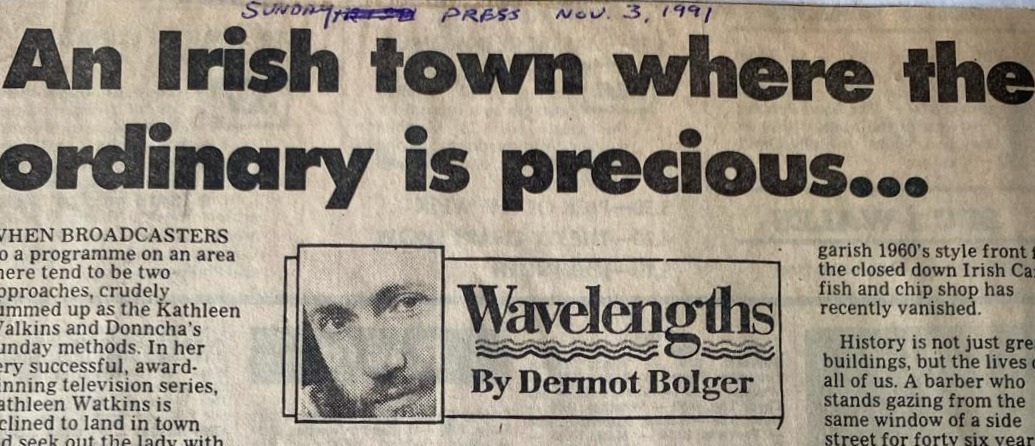
An Irish town where the ordinary is precious.. · Shared by Dermot Bolger
In many respects Dermot Bolger's article in the Sunday Press from Novemeber 3rd 1991 brought this local history project into being three decades later. From the pen of Ferguson Road's most famous poet:
"When broadcasters do a programme on an area there tend to be two approaches, crudely summed up as the Kathleen Walkins and Donncha's Sunday methods. In her very successful, award-winning television series, Kathleen Watkins is inclined to land in town and seek out the lady with the finest rose garden, the local craft industry made good and other figures who will reflect well on the locality.
"Donncha on his show, on the other hand, is inclined to end up in the smokiest corner beside the oldest, most annoymous figure and coax out the most bizarre, unlikely and actually true stories about the lives of oridinary people in a place. While Kathleen Watkins' programmes attempt to give a sense of the achievement of a place, Donncha often captures something which is extraordinarily precious because it is on the verge of slipping away. Those people he interviews have at times died by the time the programme is broadcast or are mentioned on later programmes as having died not long after.
"Exhibitions and publications about a place often follow these similar patterns. If the rest of this article is about one small part of Dublin, Drumcondra, it could really be any area of a city or any small rural parish.
"Currently [1991] running in Drumcondra library, as "The Drumcondra Residents Association contribution to Dublin's Cultural Year" is a fine exhibition of photographs of "historical interest to Drumcondra and ajoining areas". They are taken by a local photographer, Bernard McLeod, are of a high standard and are most certainly worth a visit to see - the two that stand out for me being the long disused Glasnevin Railway station (which I have passed for years without knowing) and the grave of Francis Johnston in the hidden St George's Cemetery, which the thousands of motorists who travel along Whitworth Road every day are not aware they are passing.
"A central figure to the exhibition is the architect James Gandon, who died in 1824 and is buried in The Church of Ireland Burial Ground on Church Ave. Drumcondra. Not only are there many references to his grave but also photographs of many of his fine Dublin buildings. Anyone who has visited Emo in Laois and seen that most superb of church spires there needs no reminding of just how fine a craftsman Gandon was, and Drumcondra is right to be proud of its associations with him.
"But looking at Bernard McLeod's excellent photographs another exhibition that-might-have-been came to mind, one which the Drumcondra Residents Association might have staged side by side with it, and one that would challenge the assertions of that word "historical".
"A hundred yards from Drumcondra library there is a small old-fashioned shop front for a cracked sign for Padd Fallon's barber shop. A notice in the window reads "1945-1991. Dear Friends and Customers, after 46 years in business I am retiring and would like to thank you all for your support down the years.
"The notice goes on to give his home phone number in case he can be of any help in the future to anyone. A few doors down, just in the past month the small Tolka Drapery has also closed. While neither shop is exactly Reids of Parliament Street, both are unique. No modern shop will ever open in their layout again. In the lane behind them the amazingly garish 1960s style front for the closed down Irish Cafe fish shop has recently vanished.
"History is not just great buildings, buit the lives of all of us. A barber who stands gazing from the same window of a side street for forty six years may probably tell us more of the real history of our society than if a hundred and fifty year old architect returned blinking into life.
"Because the most interesting parts of history are the bits that slip through the public events of the history books. What an amazing exhibition it would be, and what a genuine contribution it would make to the real culture of a capital, if the oridinary people of an area just took out their own old photographs.
"If there were snapshots of children on a road forty years ago, glimpses in the background of neighbours in gardens where newer residents now live, faded photographs of the Tolka in its famous flood among the houses, of homecomings and departures, the clothes people wore on route to dances in the 1940s, all the secret every day history that lies hidden in photo albums that have not been touched for years.
"History is inclined to focus on the extraordinary, but the extraordinary is only extraordinary. The ordinary, because it leaves no trace behind it, is precious."