
Places2 min read
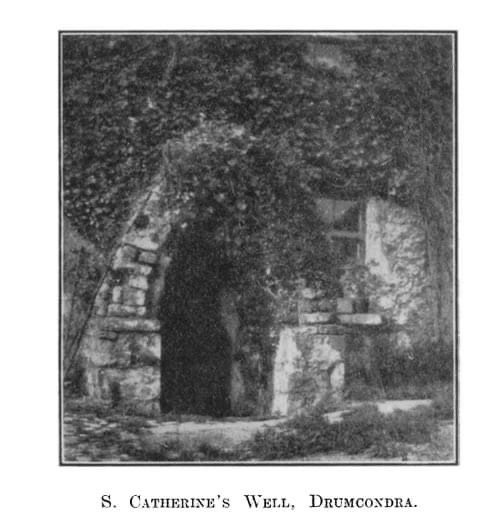
St. Catherine's Well
Sound advice from the 1800s.. · Shared by from Gary Branigan's Ancient and Holy Wells of Ireland 2012
"The spring of St. Catherine's Well rose beneath the kitchen floor of a house in Millbourne Avenue, Drumcondra, and from there it was culverted to a rustic pointed well chamber built onto the side of the house itself. When the house was demolished, the municipal authorities took great care to protect the well and preserve it within a section of ornamental shrubbery, but both have now disappeared and its present location is along the main walkway in Griffith Park…[no] surface remains of the well exist, but a brass plaque attached to the railings of the park [are the] approximate location as being the site of the well” (Branigan, 2012 - The History Press Ireland).
This Holy Well was said to cure many ailments, but in particular St. Catherine's was famed for remedying eye disorders, whooping cough and toothaches. In his book, Ancient and Holy Wells of Ireland, Gary Branigan notes that to obtain a cure, “water was drunk from a skull, strongly pointing to pre-Christian practice.”
But before racing to the junction of Ferguson and Millbourne, skull under your arm, perhaps take a second opinion..
In 1883 Dr Nedley, Consulting Sanitary Officer reported to the Commissioners of the Drumcondra township on the condition of St. Catherine's Well.
The Freeman’s Journal of 09 November 1883 records his report:
"Two mill races form rude terraces between the road and the river. The upper one is at most times sluggish and for the greater portion of the year quote stagnant. On the ground between it and some of the dwellings pig and poultry freely walking about and abominations of the foulest nature fester in the summer time upon its surface and around it.
"Being higher than the adjoining St Catherine’s Well – a surface well – which has a great local reputation for its purity, its foul juices must naturally percolate through intervening soil and contaminate the water.
"Such wells are dangerous factors in the production of disease and should in every instance be left alone as beverage."
abominations? Gulp!